Does Page Speed Affect Your Visibility in AI Search Results?
Search is changing quickly. People are no longer relying only on traditional blue links to find information. AI-generated answers now appear directly in search results, while platforms such as ChatGPT, Google AI Overviews, Microsoft Copilot, Perplexity, and Gemini increasingly help users discover information.
That raises an important question for website owners and SEO professionals: does page speed affect whether a website appears in AI-generated search results?
The relationship is not as straightforward as saying that faster websites automatically receive more AI citations. There is no established rule that simply having a faster page guarantees better visibility in AI search. However, website performance can influence several technical factors that determine whether search systems can access, process, and understand your content.
In other words, page speed is not necessarily an AI visibility ranking factor on its own. It is part of the technical foundation that can support search visibility.
What Is AI Search Visibility?
AI search visibility refers to how often a website, brand, page, or entity appears in AI-generated search experiences.
A website can become visible through:
- A citation or linked source
- A brand mention
- A recommendation
- A referenced webpage
- An entity included in an AI-generated answer
Traditional SEO usually focuses on rankings, impressions, clicks, and organic traffic. AI search adds another layer: whether your content is selected and referenced when an AI system generates an answer.
This is why monitoring AI visibility is becoming increasingly important. AI visibility trackers, such as SE Visible, can help marketers track how brands appear across AI answers. For example, you can see whether your brand is mentioned, which of your pages are cited as sources, and how often competitors show up in the same answers.
But before an AI system can reference a page, that page generally needs to be discoverable and accessible.
How AI Search Systems Find and Use Web Pages?
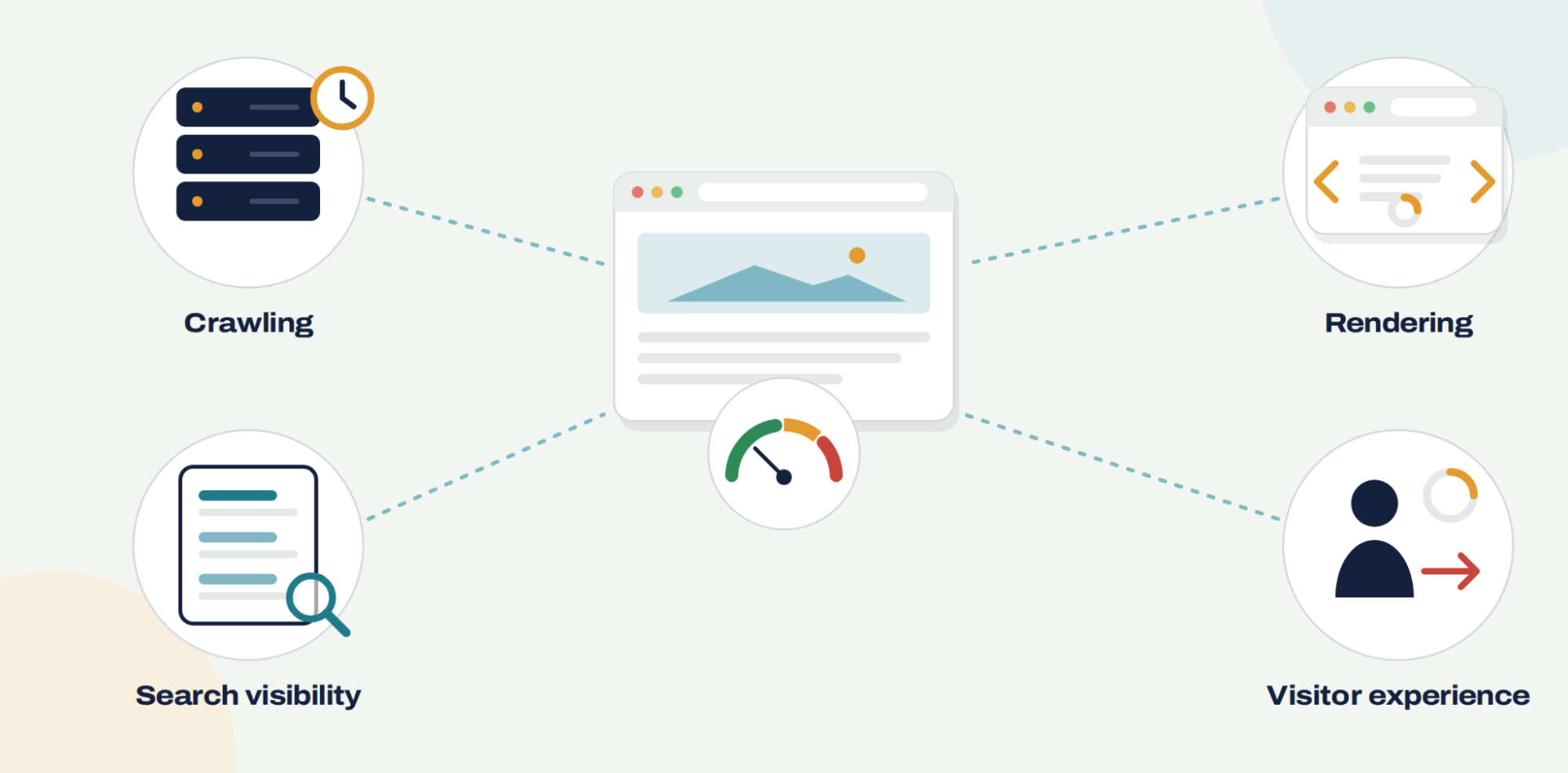
Although AI search systems differ in how they work, the basic process can be simplified into several stages:
Crawl → Render → Process → Retrieve → Generate → Cite
A system first needs to discover a page. It then needs to access and process the content before that information can potentially become part of its searchable knowledge or retrieval system.
This is where technical performance becomes relevant.
A page that takes a long time to respond, depends heavily on client-side JavaScript, returns errors, or makes important information difficult to access can create additional barriers.
It is also important to distinguish between different crawlers and search systems. Not every AI crawler necessarily handles JavaScript in the same way as Googlebot. Some systems may have limited rendering capabilities, which means content that only becomes available after JavaScript execution may be harder for them to process.
That makes accessible HTML particularly important.
Does Page Speed Directly Affect AI Search Rankings?
There is currently no simple rule that says:
“The faster the page, the more likely AI systems are to cite it.”
A fast page can still have poor AI visibility if its content is irrelevant, outdated, inaccurate, shallow, or difficult to understand.
For example, imagine two websites answering the same question. One loads extremely quickly but provides a short, generic answer. The other takes slightly longer but contains detailed, original information that directly answers the user's question.
Speed alone does not make the first page more useful.
AI search systems need information they can understand and use. This means content quality, relevance, authority, accessibility, and structure remain important.
Page speed is better viewed as an enabling factor rather than a standalone AI ranking signal.
Where Page Speed Can Influence AI Visibility?
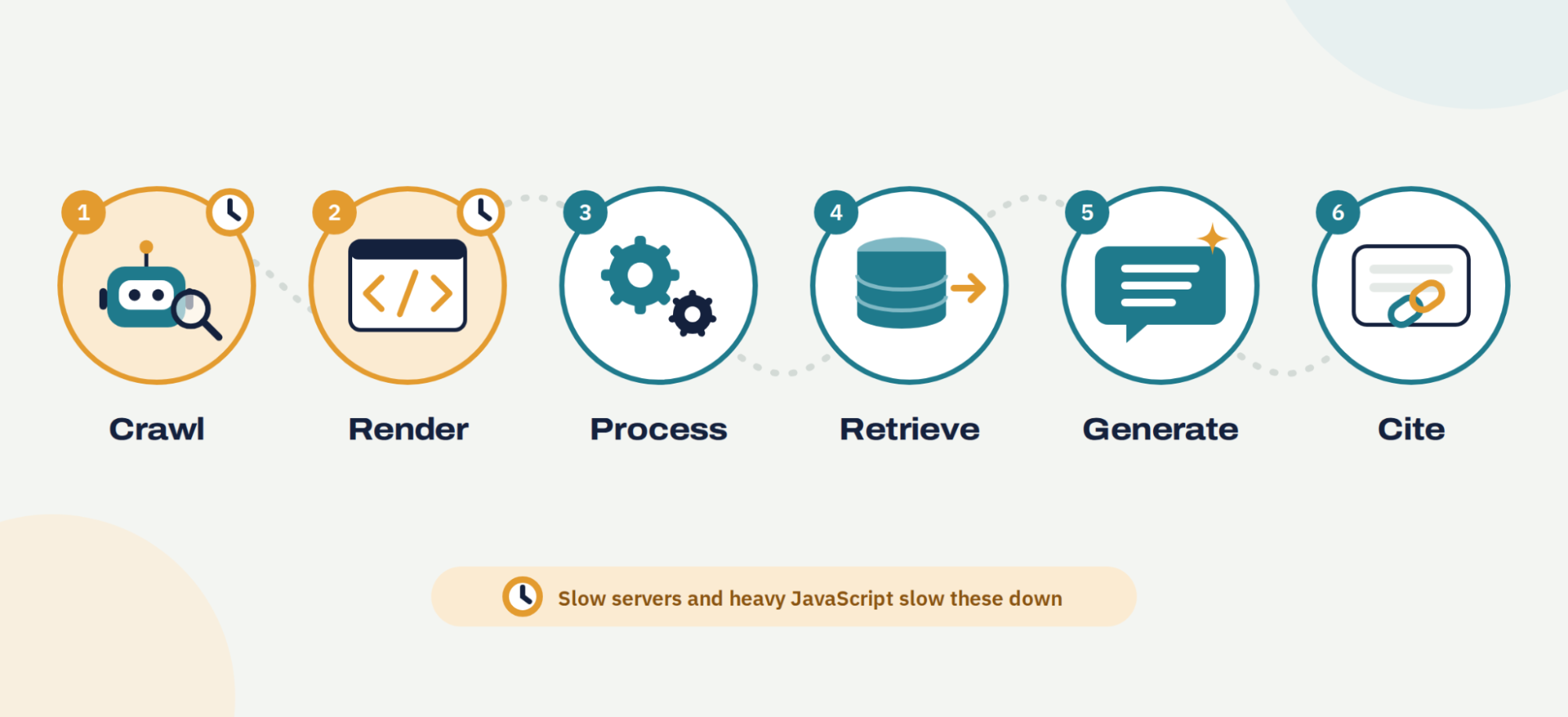
Even if speed does not directly determine AI citations, performance can affect several parts of the search journey.
1. Crawling and Retrieval
A server that responds slowly or frequently produces errors can make crawling less efficient.
Consistently slow server responses, timeouts, broken pages, or excessive redirects can create technical problems that affect how reliably content can be accessed.
Good server performance therefore helps create a more dependable environment for crawlers.
2. Rendering and Content Accessibility
Modern websites often rely heavily on JavaScript.
That is not automatically a problem, but it can become one when important information is unavailable in the initial HTML and only appears after scripts execute.
If a crawler cannot properly render the page, it may not see the same content that a human visitor sees.
For AI search, making important information available in accessible HTML can reduce this dependency.
3. Traditional Search Visibility
AI search does not exist completely separately from traditional search.
Search engines still rely on established systems for discovering, crawling, indexing, and evaluating web content. Technical problems that hurt traditional search visibility can therefore indirectly affect your chances of being discovered and considered in AI-powered search experiences.
4. Experience After an AI Citation
There is another side to AI visibility: what happens after someone clicks your citation.
If an AI system sends a visitor to your website and the page takes several seconds to load, users may leave before consuming the content.
Page performance therefore matters not only for being discovered but also for the experience that follows a search interaction.
A Practical Framework for Making Pages AI-Ready
You do not need to rebuild your entire website specifically for AI search. Start with the fundamentals.
1. Make the Page Crawlable
Check robots.txt, meta robots directives, status codes, canonical tags, and internal links. Make sure important pages are discoverable.
2. Keep Important Content Accessible
Do not hide essential answers behind unnecessary JavaScript, interactions, or complicated rendering processes.
3. Improve Server Performance
Look at hosting, caching, database performance, CDN configuration, and server response times.
4. Improve User-Facing Performance
Optimize images, reduce unnecessary scripts, remove unused resources, and improve Core Web Vitals where problems exist.
5. Structure Content Clearly
Use descriptive headings, concise answers, logical sections, relevant internal links, and supporting information. Make it easy for both people and machines to understand what each page is about.
What Matters More Than a Perfect Speed Score?
A practical priority order is:
Crawlability → Indexability → Accessible content → Clear answers → Useful information → Internal linking and topical coverage → Server performance → Core Web Vitals → Ongoing monitoring
AI citations should be treated as an additional visibility outcome rather than something that can be achieved through one technical optimization.
The goal is not to make a website fast for AI. The goal is to build a website that is fast, accessible, crawlable, understandable, and genuinely useful.
How to Measure AI Visibility and Page Performance?
Measuring performance and AI visibility separately can help you understand whether improvements are actually making a difference.
For technical performance, monitor:
- LCP, INP, and CLS
- TTFB
- Page size
- JavaScript usage
- Image weight
- Server errors
- Redirects
- Crawl and indexing issues
For traditional search, monitor:
- Impressions
- Clicks
- Search queries
- Indexed pages
- Organic landing pages
- Crawl issues
For AI visibility, look at:
- Brand mentions
- Cited URLs
- AI-generated answer appearances
- Target queries and topics
- Competitor mentions
- Frequently cited sources
- Changes over time
This last category is particularly important because traditional rankings do not tell you the whole story anymore.
Also remember that correlation does not prove causation. If traffic or AI mentions increase after a speed improvement, that does not automatically mean speed caused the increase. Other changes to content, links, indexing, competition, or search systems may have contributed.
Key Takeaways
Page speed can influence AI search visibility, but mostly through the technical systems around search rather than through a simple direct ranking rule.
Ultimately, page speed is one piece of the AI search visibility puzzle. A technically efficient website gives search systems fewer barriers to accessing your content, but strong visibility still depends on whether that content provides something worth finding, understanding, and citing.