Best RUMvision Alternatives in 2026

RUMvision is a real-user monitoring (RUM) tool built for one job: showing how your actual visitors experience Core Web Vitals. It does that job well, with weekly reports, daily regression alerts, and a breakdown of the scripts that slow your pages down.
However, it has no lab tests, no free plan, and its cheapest plan costs €150/month before VAT. So, is there a RUMvision alternative that gives you RUM and lab testing for less? Let us find it out today!
SpeedVitals is the best RUMvision alternative for most website owners, agencies, and developers. RUM is included on every SpeedVitals plan, even the Free plan, and the $99/month Pro plan covers 200,000 RUM page views across 10 websites. Unlike RUMvision, the same plan also includes lab tests from 35 locations, TTFB tests from 40+ locations, and scheduled monitoring. So you can reproduce and fix what RUM finds without paying for a second tool.
Since SpeedVitals is our own product, I've listed its cons just as plainly as everyone else's. Here's how the alternatives compare at a glance (monthly billing, from each pricing page at the time of writing):
| Tool | Best For | Lab Tests | Free Plan | Paid RUM Plans From |
|---|---|---|---|---|
| SpeedVitals | RUM and lab testing on any budget | ✅ | ✅ | $19/month |
| DebugBear | RUM, lab tests, and white-label reports | ✅ | ❌ 14-day trial | $125/month |
| CoreDash | The cheapest RUM-only option | ❌ | ❌ 14-day trial | $20/month |
| SpeedCurve | Large teams with performance budgets | ✅ | ❌ | $90/month |
| Calibre | Many small, low-traffic sites | ✅ | ❌ 15-day trial | $75/month |
| Cloudflare Web Analytics | Basic Core Web Vitals for free | ❌ | ✅ | N/A |
| RUMvision (for reference) | RUM only, high-traffic sites | ❌ | ❌ | €150/month |
Why Look for a RUMvision Alternative?
RUMvision gets a lot right. It shows Core Web Vitals from real visitors without the 28-day delay of Google Search Console, and it rates your first-party and third-party scripts by their real impact. You also get weekly reports, daily regression alerts, and a CrUX comparison with up to 10 competitors.
On top of that, it has setup guides for single-page apps (including Next.js and Nuxt), an API and an MCP server for AI clients, and data stored in the EU. Both plans include a free 1-hour setup call and monthly support.
The reasons people look elsewhere are the entry price, the way domains are counted, and the missing lab tests.
Pricing Starts at €150/Month
RUMvision has two plans, both billed in euros:
| RUMvision Plan | Monthly Billing | Annual Billing (per Month) | Page Views per Month | Domains | Data Retention |
|---|---|---|---|---|---|
| Growth | €150 | €135 | 1.5 million | 2 | Not listed |
| Scale | €700 | €630 | 7.5 million | Up to 5 | 13 months |
Extra page views cost €75/month per million when you buy them up front, and autoscaled page views cost €25 more than that. Annual billing saves 10% on the base subscription. Prices exclude VAT: Dutch companies pay 21% on top, while companies outside the Netherlands pay none once they provide a valid VAT number or an equivalent. The pricing page lists no free plan and no free trial, only a free 30-minute demo.
For a high-traffic store, 1.5 million page views for €150 works out to €100 per million, which is cheap. But a blog or a small store with 30,000 monthly page views pays the same €150/month and uses 2% of its quota.
Domains Add Up Quickly
RUMvision counts every subdomain and every top-level domain as a separate domain. So example.com, shop.example.com, and example.de take three domain slots, and its FAQ says the same applies to a separate checkout, landing page, or staging domain. Growth includes 2 domains, and each extra one costs €20/month.
For an agency that monitors 10 client sites on Growth, that's 8 extra domains, or €160/month on top of the €150 base. SpeedVitals Pro covers 10 websites for $99/month, though with 200,000 page views in total instead of 1.5 million.
No Lab Tests
RUMvision only collects field data. Its glossary lists Lighthouse and WebPageTest as examples of synthetic monitoring, but RUMvision doesn't run lab tests itself. So when RUM tells you that INP is poor on your product pages, you need a second tool to reproduce the problem, read the waterfall, and check your fix before it reaches visitors.
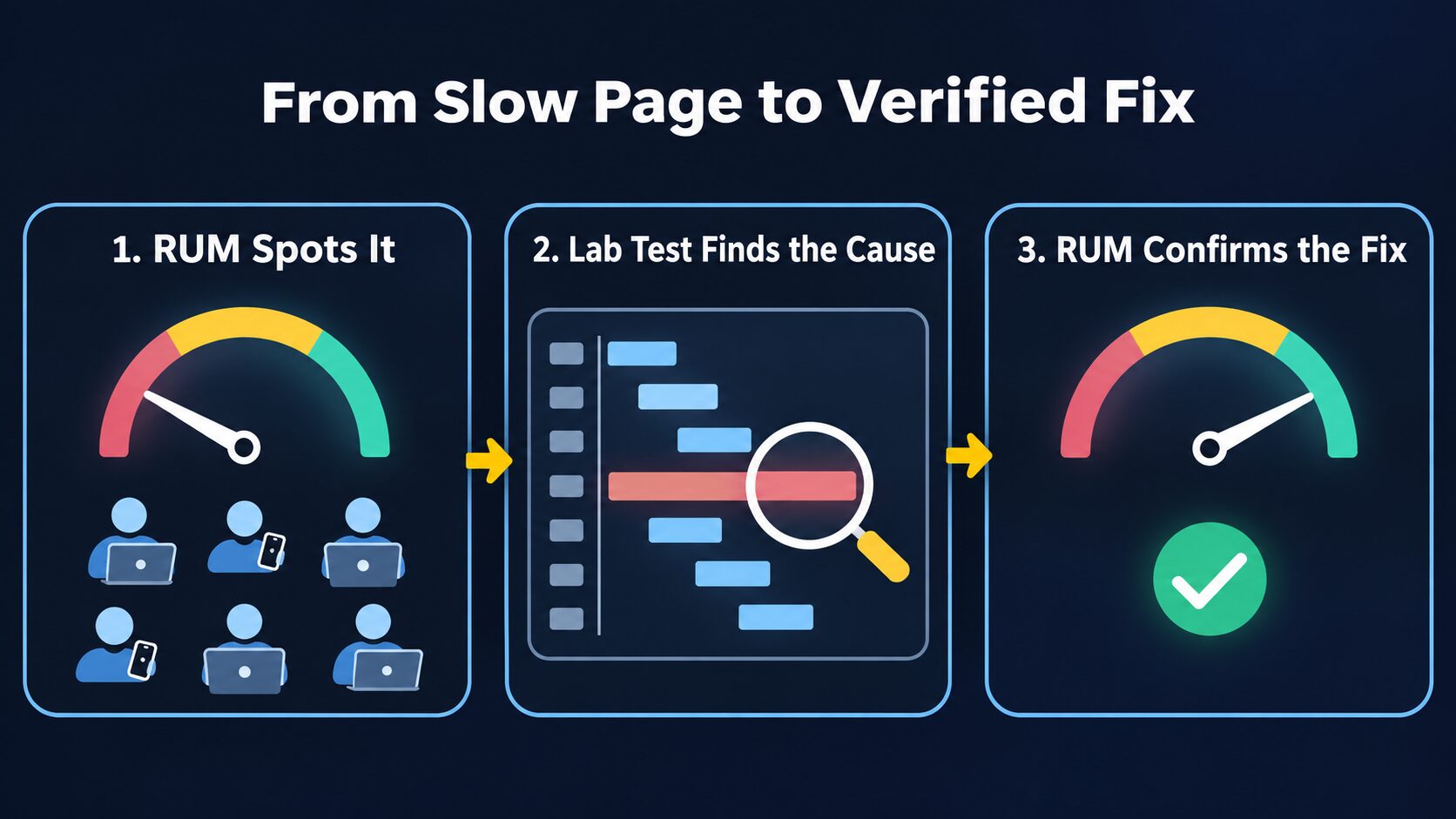
RUM is the first and the last step here. It tells you which pages and metrics fail for real visitors, and later whether your fix worked for them. The middle step needs a lab test you can repeat as often as you like, under the same conditions every time.
What to Look for in a RUMvision Alternative
Performance tools report three kinds of data. A lab test loads your page under fixed conditions (one device, one network, one location). CrUX (the Chrome User Experience Report), which PageSpeed Insights and Search Console show, reports the 75th percentile of opted-in Chrome users over a rolling 28-day window. RUM measures every visit to your own site through a small script, so a regression shows up the day you deploy it.
Our guide on field data vs origin summary explains the CrUX side in more detail.
The gap between lab and RUM numbers can be huge. One Redditor saw a TTFB of 160 ms in Lighthouse, while their real-user data showed 1.4 s, even though their static files such as fonts and icons came from a CDN.
That can happen when the CDN serves only static assets and not the HTML document, so visitors still wait for the origin server. A Lighthouse run from one machine also says nothing about visitors far away from that server. If your RUM TTFB is far above your lab TTFB, run a TTFB test from several locations and check whether your HTML is a cache hit. Our guide on reducing server response time covers the fixes.
Before switching, I'd check these five things:
- RUM with attribution: the LCP element, INP split into its subparts, and the scripts behind long animation frames. RUMvision's script breakdown is one of its strengths, so check that the alternative names the scripts as well as the elements.
- Lab tests in the same tool: so you can reproduce what RUM finds without a second subscription.
- Price at your traffic and site count: what your monthly page views and number of domains cost on each plan.
- RUM data retention: how many months of history you get on the plan you'll actually buy.
- Alerts and reports on RUM data: RUMvision sends daily regression alerts and weekly reports, so check what the alternative offers for RUM specifically.
Another person on Reddit found that Vercel Speed Insights looked nice but didn't give them enough detail to fix a poor INP. They ended up logging the metrics themselves with Google's web-vitals library and pairing them with session replays, which finally led them to a menu dropdown. A RUM tool with proper INP attribution should save you that detour.
For this list, I compared each tool's current pricing and documentation on these five points. Our team has used SpeedVitals and DebugBear extensively over the years. For RUMvision, CoreDash, SpeedCurve, Calibre, and Cloudflare Web Analytics, this is an assessment based on their public documentation, and we didn't run a controlled benchmark of the tools for this article.
What RUM Costs at Your Traffic Level
Entry prices hide a lot, so I worked out the cheapest monthly plan that covers one website at four traffic levels (monthly billing):
| Monthly Page Views | RUMvision | SpeedVitals | DebugBear | CoreDash | SpeedCurve |
|---|---|---|---|---|---|
| 5,000 | €150 | Free | $125 | $20 | $90 |
| 20,000 | €150 | $49 | $125 | $20 | $90 |
| 200,000 | €150 | $99 | $144 | $39 | $90 |
| 1,000,000 | €150 | $399 | $219 | $89 | $135 |
| Lab tests included | ❌ | ✅ | ✅ | ❌ | ✅ |
At 200,000 page views or less, every other tool in this table has a lower sticker price than RUMvision's €150, and the euro price doesn't include VAT. At 1 million page views, the order changes: RUMvision's Growth plan covers that traffic for €150, while SpeedVitals needs the $399 Ultimate plan.
Apart from the SpeedVitals Free plan at 5,000 page views, CoreDash is the cheapest option at every level here, but like RUMvision, it has no lab tests. The DebugBear prices at 200,000 and 1 million page views use its $69/month Intro plan with RUM added in blocks of 500,000 page views. The SpeedCurve prices cover RUM only, with no synthetic checks. Calibre isn't in the table because it counts sessions, not page views.
SpeedVitals
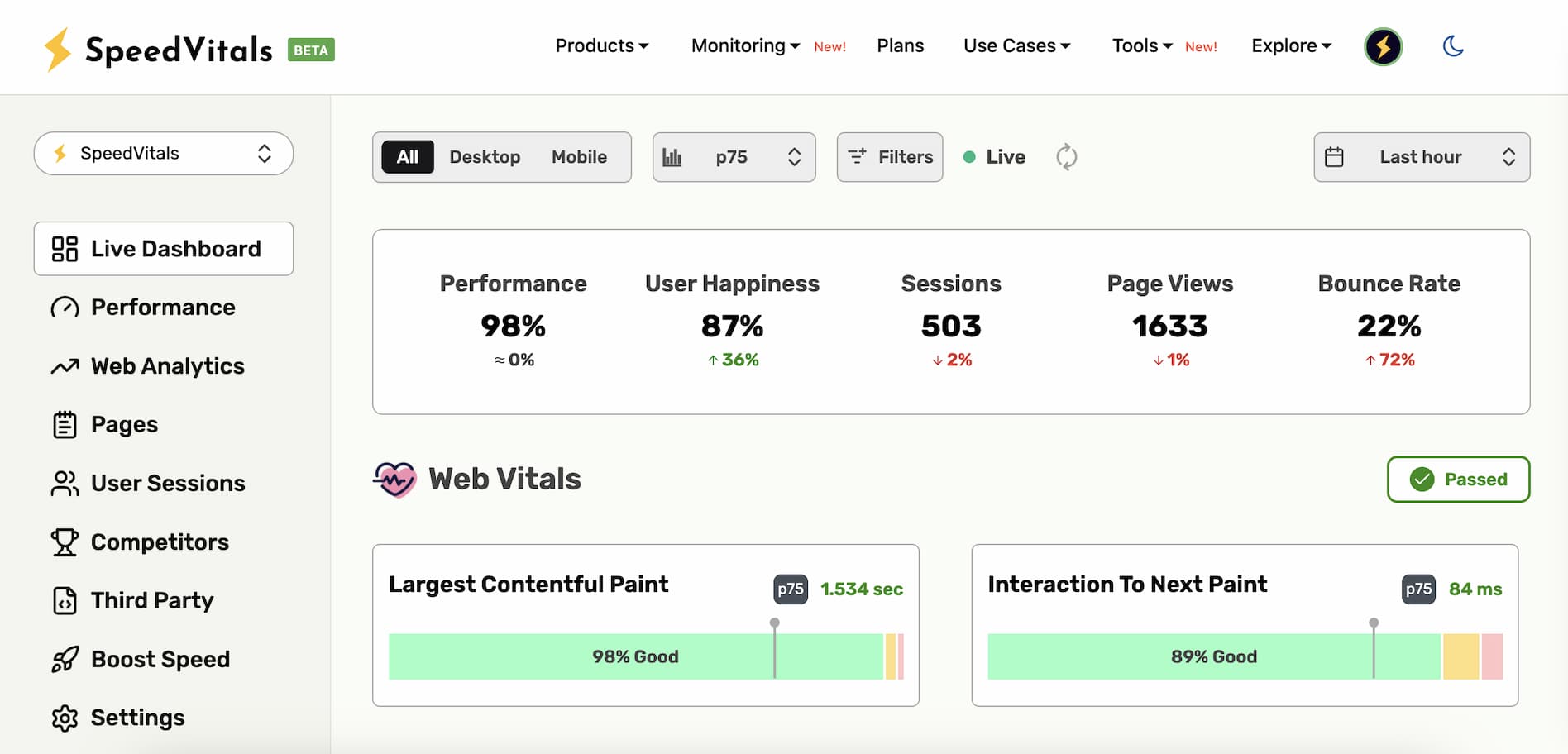
SpeedVitals covers both things a RUMvision user usually pays two tools for: real-user monitoring of LCP, INP, and CLS, and lab testing with scheduled monitoring. RUM is included on every plan, including the Free plan (5,000 page views a month on one website).
The RUM side includes:
- Live dashboard: the p75 LCP, INP, and CLS of your visitors as they happen, instead of a 28-day CrUX average.
- Attribution: the elements and interactions causing high LCP, INP, and CLS, with INP split into input delay, processing duration, and presentation delay.
- Third-party section: every third-party script with a long load time or long animation frames, plus lighter alternatives where they exist.
- Waterfall for real visits: the request waterfall you know from our speed test, recorded for actual page views.
- Competitors: finds your competitors automatically and compares your RUM data with their CrUX data, much like RUMvision's competitor comparison.
- Built-in web analytics: sessions, bounce rate, traffic sources, and country and city data, without cookies.
- Easy setup: plugins for WordPress, Shopify, Joomla, and Drupal, plus SPA support for React, Vue, Svelte, and Angular apps.
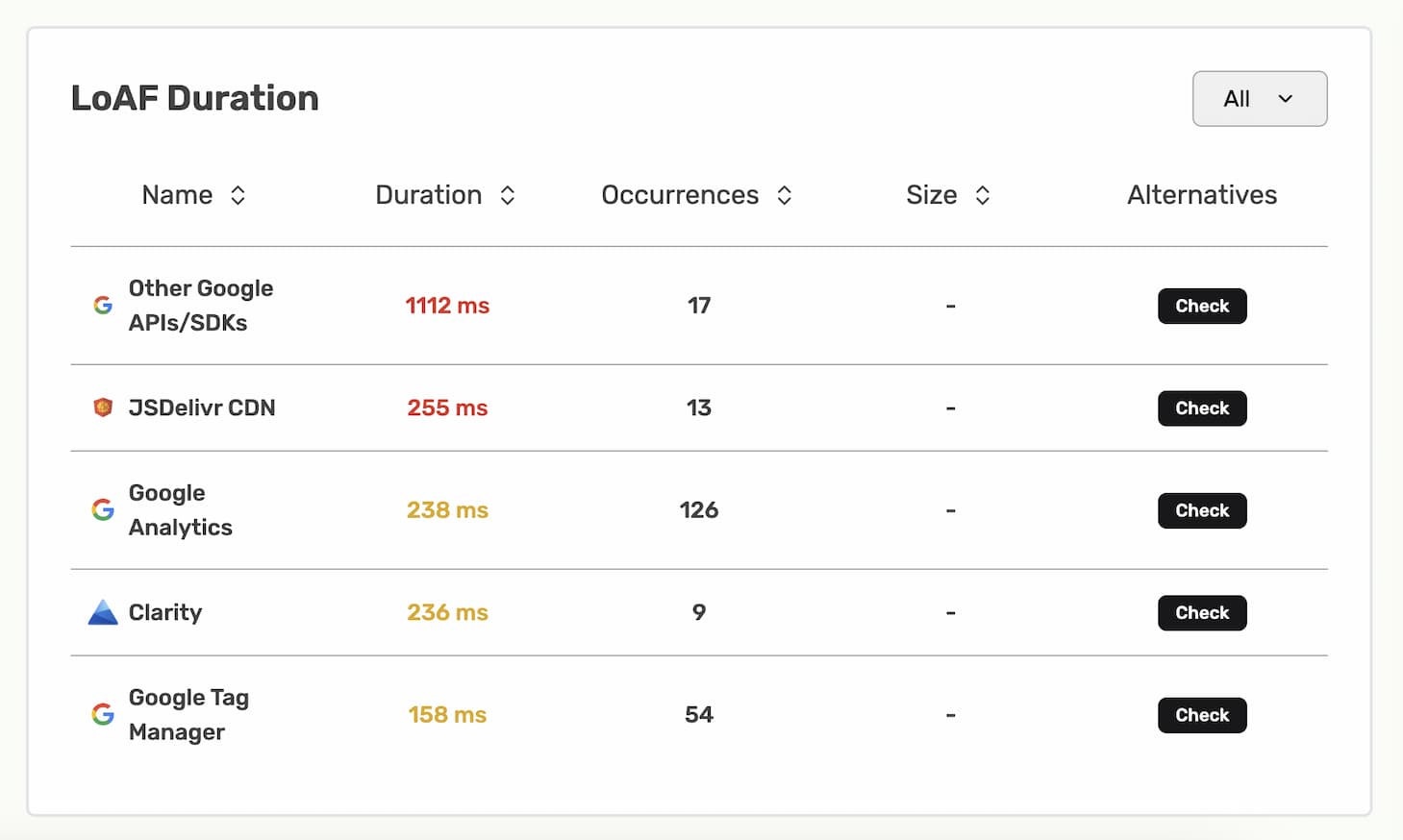
This screenshot is from our RUM public beta in June 2025. Other Google APIs and SDKs caused 1,112 ms of long animation frames over 17 occurrences, more than four times the 238 ms that Google Analytics caused over 126 occurrences.
Where RUMvision rates scripts as good, moderate, or poor, you see the actual long-frame time here. When a low-priority script tops this list, delaying it until user interaction is often the quickest fix. Just never delay a consent manager, a checkout script, or anything needed above the fold.
This is where SpeedVitals and RUMvision differ the most. When RUM flags a slow page, you can open the website speed test in the same account. It gives you a waterfall, a layout shift visualizer, code coverage, and a ready-made preload snippet for the LCP image. The TTFB test measures response times from 40+ locations with cache status and CDN detection, and the batch test runs one URL across many locations and devices in one go. Scheduled monitoring covers both speed and TTFB, and the free INP debugger clicks through your page to find slow interactions.
Here are the SpeedVitals plans and their RUM limits:
| SpeedVitals Plan | Monthly Price | RUM Page Views per Month | RUM Websites | RUM Performance Data Retention | Speed + TTFB Tests per Week |
|---|---|---|---|---|---|
| Free | $0 | 5,000 | 1 | 3 months | 15 + 15 |
| Starter | $19 | 5,000 | 1 | 3 months | 300 + 300 |
| Growth | $49 | 20,000 | 3 | 1 year | 750 + 750 |
| Pro | $99 | 200,000 | 10 | 2 years | 1,500 + 1,500 |
| Ultimate | $399 | 1,000,000 | Unlimited | 2 years | 3,500 + 3,500 |
Compared with RUMvision, the biggest difference is at the low end. You can start for free instead of paying €150/month, and Pro covers 10 websites with no per-domain fee. Speed test locations go from 10 on Free and Starter to 35 on Growth and above, and yearly billing gives you two months free.
At high traffic, though, RUMvision costs less. Its Growth plan covers 1.5 million page views for €150, while SpeedVitals Ultimate covers 1 million for $399/month. Ultimate does add unlimited websites, 3,500 speed tests and 3,500 TTFB tests a week, and hourly TTFB monitoring. Pro and Ultimate can also buy extra RUM page views as an add-on.
Speed monitoring runs every 24 hours on Free and Starter, down to every 3 hours on Ultimate, with email alerts from Starter, Slack from Growth, and webhooks from Pro. Team members start on Growth.
Now the cons. RUM alerts and the RUM weekly digest are still marked as coming soon, while RUMvision already sends daily regression alerts and weekly reports (alerts for synthetic monitoring are live on SpeedVitals). SpeedVitals also has no white-label reports, API access starts on the Pro plan, and the Free and Starter plans keep only 3 months of RUM performance data.
| Pros | Cons |
|---|---|
| ✅ RUM on every plan, including Free | ❌ RUM alerts and weekly digest still coming soon |
| ✅ Lab tests, TTFB tests, and monitoring in the same plan | ❌ Costs more per page view at 1 million+ page views |
| ✅ 10 websites on Pro with no per-domain fee | ❌ No white-label reports |
| ✅ LCP, INP, and CLS attribution | ❌ API access only on Pro and above |
| ✅ Third-party LoAF breakdown with alternatives | ❌ 3 months of RUM data on Free and Starter |
| ✅ Request waterfall for real page views | |
| ✅ Competitor CrUX comparison | |
| ✅ Built-in web analytics, no cookies | |
| ✅ 1 to 2 years of RUM data from $49/month | |
| ✅ TTFB test from 40+ locations | |
| ✅ Plugins for WordPress, Shopify, Joomla, and Drupal |
If you're leaving RUMvision because of the €150/month minimum, or because you're tired of paying for a separate lab tool, SpeedVitals is the alternative I'll highly recommend. Start on the Free plan, run its RUM script next to RUMvision's for a couple of weeks, and compare the p75 numbers for the same pages before you cancel anything.
DebugBear
DebugBear is still my second favorite performance tool after SpeedVitals, and it's the most complete alternative on this list. It combines RUM, synthetic tests, and CrUX data, with INP attribution based on Long Animation Frames. You also get login and user flow testing, uptime monitors, white-label exports, and a Looker Studio integration.
Startup costs $125/month for 4,000 synthetic tests and 100,000 RUM page views. Team costs $325/month for 10,000 tests and 500,000 page views, and Corporate / Agency costs $899/month for 50,000 tests and 2 million page views. There's also a cheaper route to RUM. The $69/month Intro plan (one user, 350 synthetic tests a month) doesn't include it, but you can add it at $75/month per 500,000 page views. Every plan keeps 24 months of data and allows unlimited domains, yearly billing saves 20%, and there's a 14-day free trial.
Unlimited domains on every plan remove the domain math that makes RUMvision expensive for agencies, and 24 months of data is longer than the 13 months on RUMvision Scale. At the high end, DebugBear's Large Site plan covers 7.5 million page views (the same as RUMvision Scale) for $1,250/month, against €700/month on RUMvision. That price does include 20,000 synthetic tests. Our list of DebugBear alternatives covers its plans in more detail.
| Pros | Cons |
|---|---|
| ✅ RUM, synthetic, and CrUX in one tool | ❌ No free plan |
| ✅ Unlimited domains on every plan | ❌ RUM starts at $125/month |
| ✅ 24 months of data on every plan | ❌ Costs more than RUMvision at millions of page views |
| ✅ Login and user flow testing | |
| ✅ White-label exports and Looker Studio |
DebugBear is the better choice if you want RUMvision's depth plus lab tests, user flows, and white-label reports for clients, and the budget fits.
CoreDash
CoreDash is the closest match to RUMvision on this list. Like RUMvision, it's a RUM-only tool based in the Netherlands, and it processes and stores its data in the EU. It attributes each issue to the element, interaction, or resource behind it, and adds request waterfalls, regression alerts, AI insights, and an MCP integration. It doesn't use cookies either.
Starter costs $20/month for 75,000 page views on one site, with 6 months of data. Standard costs $39/month for 500,000 page views across up to 2 sites, with a year of data. Studio costs $89/month for 1 million page views shared across up to 10 sites, with 3 years of data. Annual billing is about 20% cheaper, and there's a 14-day free trial with no card required.
That makes CoreDash the cheapest paid way to replace RUMvision's RUM at every traffic level in the cost table above. But its plans don't include lab tests, so you'd still need a separate tool to reproduce what it finds, just as with RUMvision.
| Pros | Cons |
|---|---|
| ✅ RUM from $20/month | ❌ No lab tests in its plans |
| ✅ 10 sites and 1 million page views for $89/month | ❌ No free plan |
| ✅ Element, interaction, and resource attribution | ❌ Only 6 months of data on Starter |
| ✅ Up to 3 years of data on Studio | ❌ Studio's page views are shared across all sites |
| ✅ EU hosting, no cookies |
CoreDash is the better choice if you only want RUM and want to pay as little as possible for it.
SpeedCurve
SpeedCurve combines RUM with synthetic tests, and adds performance budgets, CI/CD integration, an API, and competitor benchmarking. Every plan includes unlimited users and teams.
You build a plan from RUM page views and synthetic checks. Its pricing calculator puts 2 million RUM page views at $270/month ($135 per million) and 30,000 synthetic checks at $450/month. Starter has a $90/month minimum, Growth starts at $576/month, and annual billing saves 20%.
That per-page-view price is in the same range as RUMvision's €100 per million on Growth. The catch is history: on plans under $500/month (or $6,000/year), you can only see the last 3 months of RUM data, compared with 13 months on RUMvision Scale. SpeedCurve has also changed owners twice in under a year. Embrace acquired it in November 2025, and Palo Alto Networks completed its acquisition of Embrace in August 2026. Our list of SpeedCurve alternatives covers both points in more detail.
| Pros | Cons |
|---|---|
| ✅ RUM and synthetic in one tool | ❌ No free plan |
| ✅ $135 per million RUM page views | ❌ Only 3 months of RUM history under $500/month |
| ✅ Unlimited users and teams | ❌ Two ownership changes in under a year |
| ✅ Performance budgets and CI/CD integration | |
| ✅ Competitor benchmarking |
SpeedCurve is the better choice for a large team with high traffic and a performance budget process wired into its CI pipeline.
Calibre
Calibre puts RUM sessions, CrUX data, and scheduled synthetic tests in one place, with unlimited sites and URLs on every plan. It also has an automation API and a command-line client.
Starter costs $75/month for 5,000 RUM sessions, 5,000 synthetic tests, 3 seats, and 90 days of RUM data. Team costs $150/month for 10,000 sessions, 15,000 tests, 10 seats, and a year of RUM data, with extra sessions at $75 per 100,000. Company costs $1,500/month, paid yearly, for 1 million sessions and 2 years of RUM data. Synthetic data is kept for the life of the account on every plan, and there's a 15-day free trial.
Since a session usually includes several page views, Calibre's quotas are far smaller than RUMvision's 1.5 million page views. On Starter, RUM tracking also pauses at 5,000 sessions until the next billing cycle. So Calibre suits low-traffic sites, not the high-traffic stores RUMvision is built for.
| Pros | Cons |
|---|---|
| ✅ RUM, CrUX, and synthetic on every plan | ❌ No free plan |
| ✅ Unlimited sites and URLs | ❌ RUM pauses at 5,000 sessions on Starter |
| ✅ Synthetic data kept for the life of the account | ❌ 90 days of RUM data on Starter |
| ✅ Automation API and CLI | ❌ Big jump from $150 to $1,500/month |
Calibre is a good fit for a small team that monitors many low-traffic sites and wants lab tests in the same tool.
Cloudflare Web Analytics
Cloudflare Web Analytics is free, and it reports LCP, INP, and CLS from your real visitors. Its Debug View lists the top five elements hurting each metric with their p75 values and page paths, and the beacon uses no cookies or local storage. Sites proxied through Cloudflare can turn it on without touching code, while other sites add a JavaScript snippet (up to 10 sites that aren't proxied).
But it's basic next to RUMvision. You can query the last six months of data, and raw beacon data stays unsampled for only 7 days before Cloudflare aggregates it to around 10%. CLS is also only measured in Chromium browsers. Its Debug View points to elements rather than scripts, and there's no competitor comparison or lab testing.
| Pros | Cons |
|---|---|
| ✅ Free | ❌ 6 months of data, aggregated after 7 days |
| ✅ LCP, INP, and CLS with the top elements | ❌ CLS only in Chromium browsers |
| ✅ No cookies | ❌ No script attribution or competitor data |
| ✅ No-code setup on proxied sites | ❌ No lab tests |
It's a good free starting point, and a quick way to check whether you need a paid RUM tool at all.
Which RUMvision Alternative Should You Choose?
Summing up, here's your best choice:
- Want RUM and lab testing without a €150/month minimum? SpeedVitals. Start on the Free plan, and Pro covers 10 websites and 200,000 page views for $99/month.
- Need RUM, lab tests, user flows, and white-label reports for clients? DebugBear.
- Only want RUM, at the lowest price? CoreDash.
- A large team with high traffic and performance budgets in CI? SpeedCurve.
- Monitoring lots of small sites? Calibre.
- No budget at all? Cloudflare Web Analytics.
For most sites leaving RUMvision, SpeedVitals gives you RUM plus the lab testing that RUMvision lacks, and it costs less up to 200,000 page views a month. The only case where I'd stay on RUMvision is a site with well over a million monthly page views that already pays for a lab testing tool. There, €100 per million page views is hard to beat.
Once RUM shows you which pages and metrics fail, our guide on website performance optimization ranks the fixes by impact.