Best SpeedCurve Alternatives in 2026


SpeedCurve is one of the most complete web performance monitoring tools around. It puts real-user monitoring (RUM), synthetic tests, performance budgets, and competitor benchmarking in one dashboard, and large teams have relied on it for years.
However, it has no free plan, the cheapest plan starts at $90/month, and SpeedCurve has changed owners twice in less than a year. So, which SpeedCurve alternative gives you the same data for less? Let's find out.
SpeedVitals is the best SpeedCurve alternative for most website owners, agencies, and developers. RUM and synthetic testing come with every plan, even the Free plan. The $99/month Pro plan keeps 2 years of RUM performance data, while SpeedCurve shows only 3 months of RUM data on plans under $500/month. The same Pro plan includes lab tests from 35 locations and TTFB tests from 40+ locations.
SpeedVitals is our own product, so I've kept its cons in this article as honest as everyone else's. Here's how the alternatives compare at a glance (monthly billing, as listed on each pricing page at the time of writing):
| Tool | Best For | Real-User Monitoring | Free Plan | Paid Plans From |
|---|---|---|---|---|
| SpeedVitals | RUM, lab tests, and monitoring on any budget | ✅ Every plan | ✅ | $19/month |
| DebugBear | SpeedCurve-level depth with white-label exports | ✅ | ❌ 14-day trial | $125/month |
| Calibre | Small teams with many low-traffic sites | ✅ (sessions) | ❌ 15-day trial | $75/month |
| RUMvision | RUM only, high-traffic sites | ✅ | ❌ | €150/month |
| WebPageTest | Deep lab testing | ❌ | ✅ 150 runs/month | $180/year |
| SpeedCurve (for reference) | Large teams with performance budgets | ✅ | ❌ | $90/month |
Why Look for a SpeedCurve Alternative?
SpeedCurve gets a lot right. Its RUM breaks INP into subparts and points to the elements behind slow interactions. Since lux.js v4.1.0 (April 2025), it also collects Long Animation Frames (LoAF) data with script attribution. On top of that, you get performance budgets with email or webhook alerts (Slack and Microsoft Teams), CI/CD integration through its REST API, and competitor benchmarking. Every plan includes unlimited users and teams.
One Redditor said they use SpeedCurve for active monitoring and RUM, and that they value RUM because it shows how their real users experience the site. But they also said some problems, such as slow interactions or a sluggish component, didn't show up in any of the monitoring tools they used. That was in 2024, before SpeedCurve added LoAF data. Still, it's a good reminder to check how deep each alternative's INP attribution goes.
The reasons people look elsewhere are the pricing model, the short RUM history on smaller plans, and the ownership changes.
Pricing Starts at $90/Month
SpeedCurve doesn't sell fixed plans. You build one from RUM page views and synthetic checks, where a check is one test of one URL in one browser from one region. Here's what its pricing calculator showed for a few setups:
| Usage per Month | Monthly Billing | Annual Billing (per Month) |
|---|---|---|
| 1 million RUM page views + 1,000 synthetic checks | $150 | $120 |
| 2 million RUM page views + 30,000 synthetic checks | $720 | $576 |
| 10 million RUM page views + 1,000 synthetic checks | $1,365 | $1,092 |
RUM costs $135 per million page views, and synthetic checks cost $15 per 1,000. The Starter plan has a $90/month minimum, so a small site with 50,000 monthly page views still pays at least $90/month. The Growth plan, which adds 13 months of data retention, high-priority support, and priority synthetic testing, starts at $576/month.
There's no free plan, and the pricing page doesn't list a free trial either. Its main call to action is a demo request.
Only 3 Months of RUM History on Smaller Plans
According to SpeedCurve's documentation, RUM data is stored for 13 months. But full access needs a monthly plan of $500 or more (or an annual plan of $6,000 or more). Smaller plans can only see the last 3 months.
That makes it hard to compare this year's holiday sale with last year's, or to show a client that a fix held up over a full year.
Two Owners in Less Than a Year
Embrace, an observability company, acquired SpeedCurve in November 2025 and said existing customers would stay fully supported. Then Palo Alto Networks completed its acquisition of Embrace on August 27, 2026, to add RUM to its own observability platform. Its announcement doesn't mention SpeedCurve by name.
Nothing says SpeedCurve is going away. But if your renewal is coming up, two ownership changes in under a year are a fair reason to review your options.
What to Look for in a SpeedCurve Alternative
SpeedCurve gives you two kinds of data. Synthetic tests load your page under fixed conditions (device, network, and location), while RUM measures every real visit through a small script. CrUX (the Chrome User Experience Report) is the third source. It's what PageSpeed Insights and Search Console show, and it reports the 75th percentile over a rolling 28-day window. Our guide on field data vs origin summary explains the CrUX side in more detail.
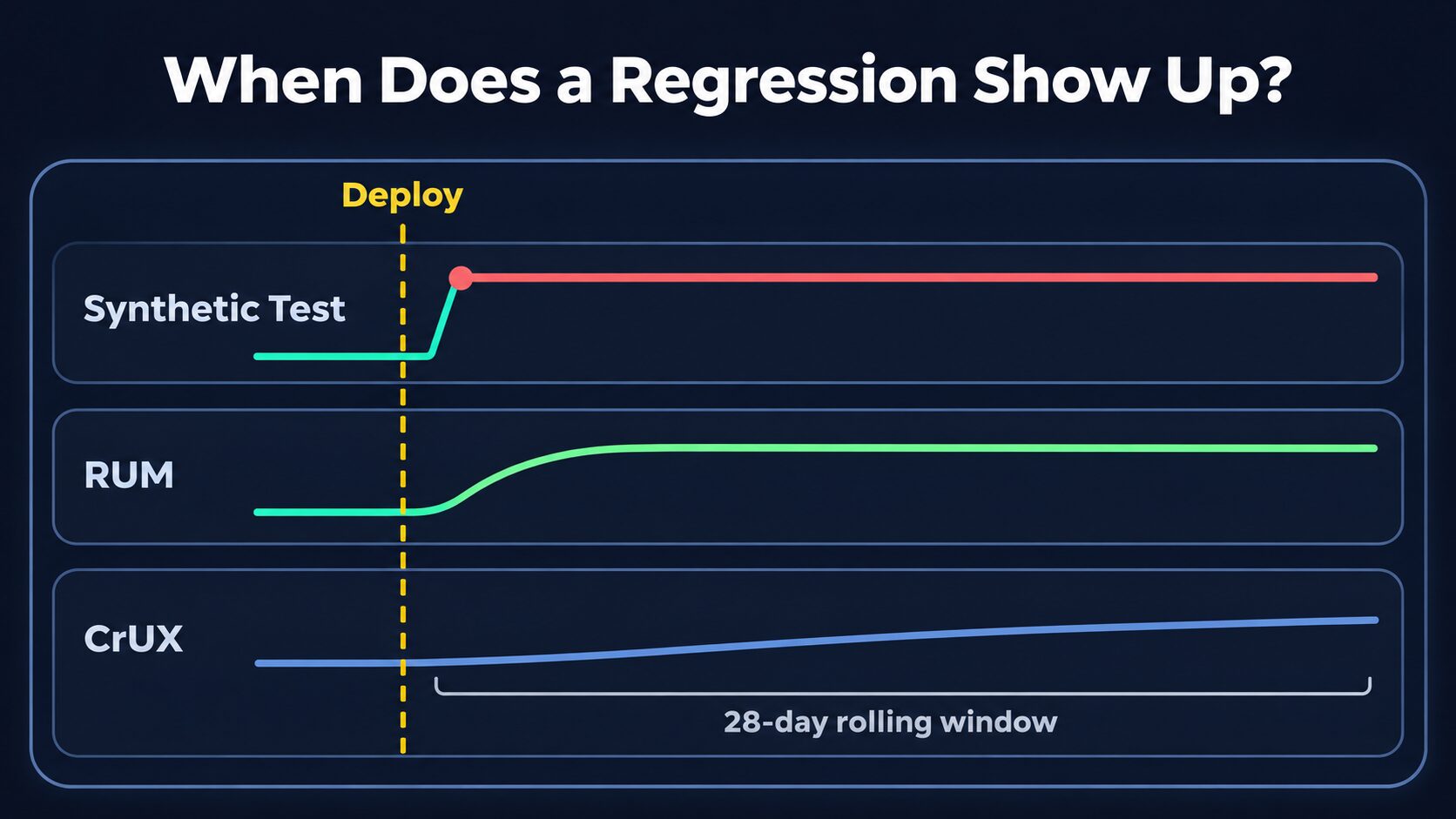
After a bad deploy, a scheduled synthetic test catches the regression on its next run, and RUM shows it as soon as visitors load the new version. CrUX mixes it with up to 28 days of older data, so it can take weeks to fully show up there.
Lab tests can also miss a problem completely. Another site owner on Reddit saw their desktop Core Web Vitals drop because of CLS, even though their lab tests showed no layout shift on desktop at all. Field data put desktop CLS at 0.12 (above the 0.1 limit for a good score), and the shifts seemed to start when they scrolled down to the sticky elements.
A lab test usually loads the page without scrolling or clicking, so a shift that happens later in the visit, such as a header turning sticky, may never appear in it. If your field CLS is worse than your lab CLS, look at everything that changes size or position after the user scrolls, and reserve space for it.
Before switching, I'd check these five things:
- RUM with attribution: the LCP element, INP subparts, and the scripts behind long animation frames. SpeedCurve has all three, so check that the alternative does too.
- Synthetic tests near your users: SpeedCurve tests from 19 AWS regions. Make sure the alternative covers the countries your traffic comes from.
- Scheduled monitoring and alerts: so you hear about a regression on the day of the deploy, not a month later.
- RUM data retention: how many months of history you can see on the plan you'll actually buy.
- Price at your traffic: work out what your monthly page views and test volume cost on each plan, not just the entry price.
For this list, I compared each tool's current pricing and documentation on these five points. Our team has used SpeedVitals, DebugBear, and WebPageTest extensively over the years. For SpeedCurve, Calibre, and RUMvision, this is an assessment based on their public documentation, and we didn't run a controlled benchmark of the tools for this article.
SpeedVitals
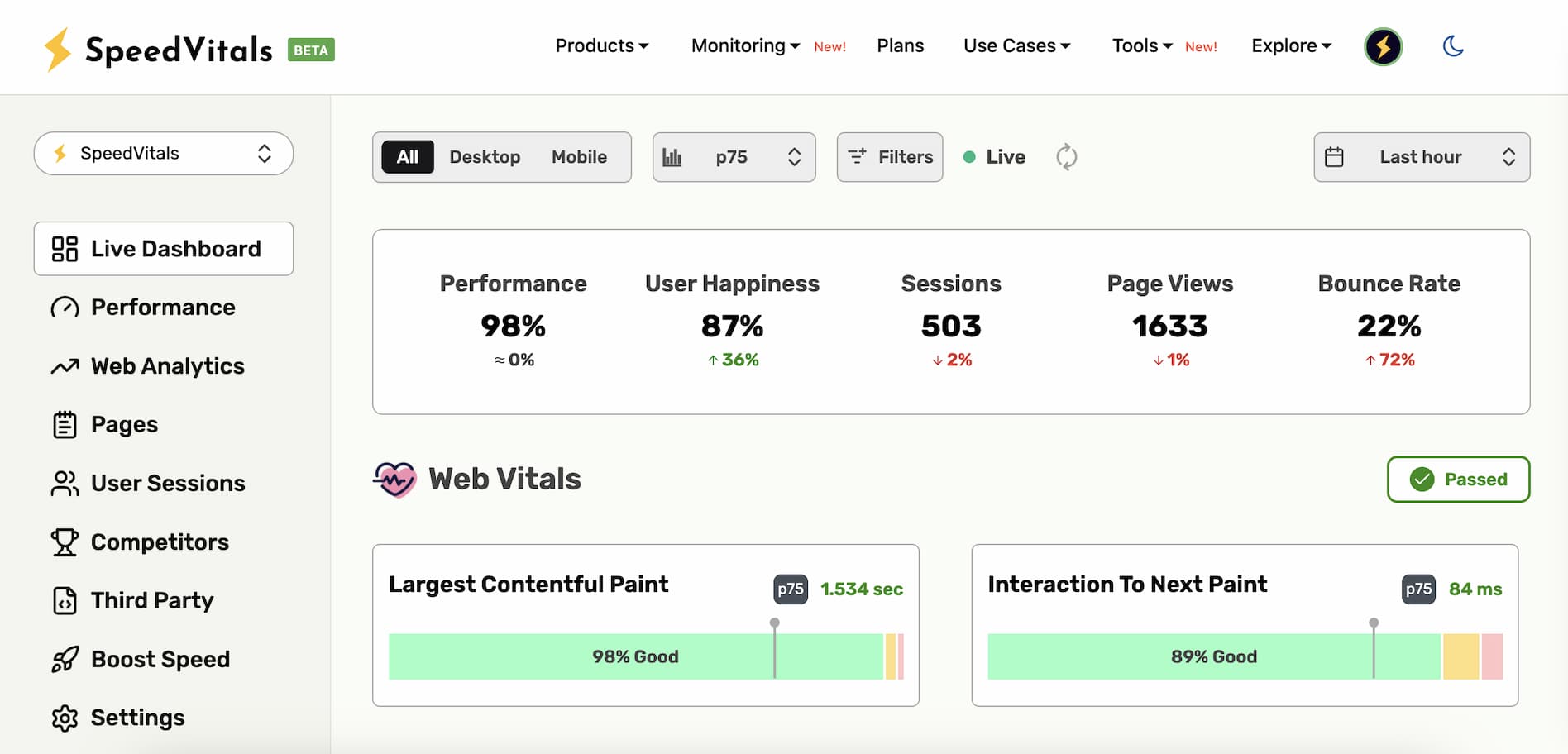
SpeedVitals covers both halves of what SpeedCurve does: real-user monitoring of LCP, INP, and CLS, and lab testing with scheduled monitoring. RUM is included on every plan, including the Free plan (5,000 page views a month on one website).
The RUM side includes:
- Live dashboard: p75 Core Web Vitals of your visitors, without the 28-day delay of CrUX.
- Attribution: the elements and interactions causing high LCP, INP, and CLS, with INP split into input delay, processing duration, and presentation delay.
- Third-party section: scripts with long load times or long animation frames, along with faster alternatives.
- Request waterfall for real page views: the same waterfall as our speed test, but for actual visits.
- Competitors: finds your competitors automatically and compares your RUM data with their CrUX data.
- Web analytics built in: sessions, bounce rate, traffic sources, and country and city data, with no cookies.
- Easy setup: plugins for WordPress, Shopify, Joomla, and Drupal, plus SPA support for React, Vue, Svelte, and Angular apps.
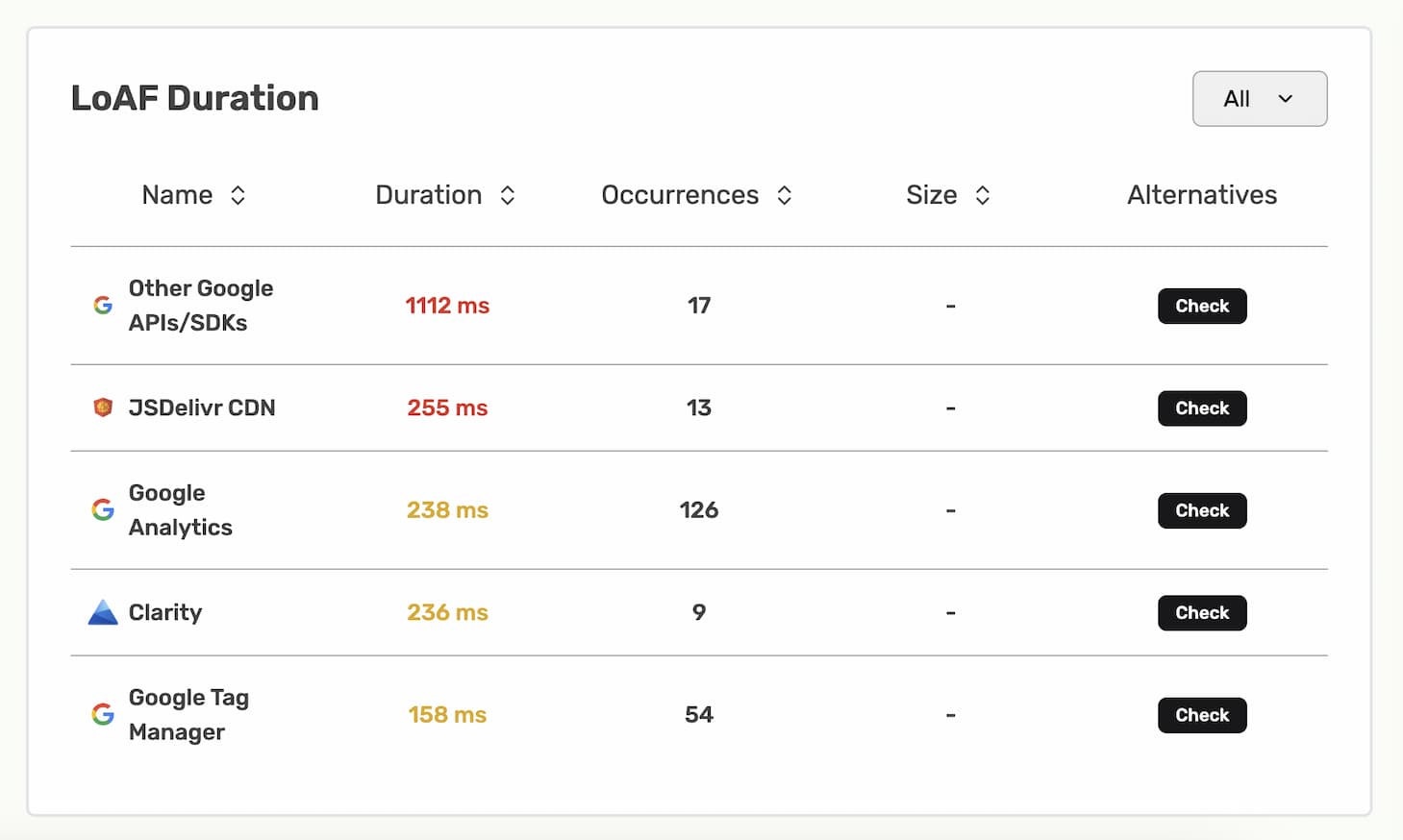
This screenshot is from our RUM public beta in June 2025. Other Google APIs and SDKs show a LoAF duration of 1,112 ms over 17 occurrences, more than four times Google Analytics (238 ms over 126 occurrences). When a script like this tops the list, delaying it until user interaction is often the quickest fix. Just don't delay a consent manager, a checkout script, or anything needed above the fold.
On the lab side, you get the website speed test with a waterfall, layout shift visualizer, code coverage, and an auto-generated preload snippet for the LCP image. The TTFB test checks response times from 40+ locations with cache status and CDN detection. The batch test runs one URL across many locations and devices at once. Scheduled monitoring covers both the speed test and TTFB, while the free INP debugger clicks through your page to find slow interactions.
These are the SpeedVitals plans at the time of writing:
| SpeedVitals Plan | Monthly Price | RUM Page Views per Month | RUM Websites | RUM Performance Data Retention | Speed + TTFB Tests per Week |
|---|---|---|---|---|---|
| Free | $0 | 5,000 | 1 | 3 months | 15 + 15 |
| Starter | $19 | 5,000 | 1 | 3 months | 300 + 300 |
| Growth | $49 | 20,000 | 3 | 1 year | 750 + 750 |
| Pro | $99 | 200,000 | 10 | 2 years | 1,500 + 1,500 |
| Ultimate | $399 | 1,000,000 | Unlimited | 2 years | 3,500 + 3,500 |
The difference from SpeedCurve is biggest for small and mid-sized sites. You can start on the Free plan instead of paying $90/month. And Growth keeps a full year of RUM performance data for $49/month, while SpeedCurve shows only 3 months below $500/month. Speed test locations go from 10 on Free and Starter to 35 on Growth and above, compared with SpeedCurve's 19 regions. Yearly billing gives you two months free.
At high traffic, though, SpeedCurve is cheaper per page view. One million RUM page views cost $135/month on SpeedCurve, against $399/month on SpeedVitals Ultimate. But Ultimate also includes 3,500 speed tests and 3,500 TTFB tests a week, hourly TTFB monitoring, and unlimited websites. Pro and Ultimate can also buy extra RUM page views as an add-on.
Speed monitoring runs every 24 hours on Free and Starter, down to every 3 hours on Ultimate, with email alerts from Starter, Slack from Growth, and webhooks from Pro. Team members start on Growth.
Now the cons. SpeedVitals has no white-label reports and no performance budgets or CI/CD integration like SpeedCurve's. RUM alerts and the RUM weekly digest are still marked as coming soon (alerts for synthetic monitoring are live), and API access starts on the Pro plan.
| Pros | Cons |
|---|---|
| ✅ RUM on every plan, including Free | ❌ No white-label reports |
| ✅ 1 to 2 years of RUM data from $49/month | ❌ No performance budgets or CI/CD integration |
| ✅ LCP, INP, and CLS attribution | ❌ RUM alerts are still coming soon |
| ✅ Third-party LoAF breakdown with alternatives | ❌ API access only on Pro and above |
| ✅ Request waterfall for real page views | ❌ Costs more per page view at millions of page views |
| ✅ Built-in web analytics, no cookies | ❌ 10 test locations on Free and Starter |
| ✅ Competitor CrUX comparison | |
| ✅ 35 lab test locations (Growth and above) | |
| ✅ TTFB test from 40+ locations | |
| ✅ Batch testing | |
| ✅ Email, Slack, and webhook alerts | |
| ✅ Plugins for WordPress, Shopify, Joomla, and Drupal |
If you're leaving SpeedCurve because of the price or the short RUM history, SpeedVitals is the alternative I'll highly recommend. Start on the Free plan, run the RUM script next to SpeedCurve's for a few weeks, and compare the p75 numbers before you cancel anything.
DebugBear
DebugBear is still my second favorite performance tool after SpeedVitals, and it's the closest match to SpeedCurve on this list. It combines synthetic tests, RUM, and CrUX data, with INP attribution based on Long Animation Frames. You also get login and user flow testing, uptime monitors, page speed experiments, white-label exports, and a Looker Studio integration.
Startup costs $125/month for 4,000 synthetic tests and 100,000 RUM page views. Team costs $325/month for 10,000 tests and 500,000 page views, and Corporate / Agency costs $899/month for 50,000 tests and 2,000,000 page views. Yearly billing saves 20%, every plan keeps 24 months of data, and there's a 14-day free trial.
That 24-month retention on every plan is a big step up from SpeedCurve's 3 months on smaller plans. At volume, the two are close: 2 million RUM page views plus 50,000 synthetic checks come to $1,020/month on SpeedCurve's calculator, against $899/month for DebugBear's Corporate / Agency plan. Our list of DebugBear alternatives covers its plans in more detail.
| Pros | Cons |
|---|---|
| ✅ RUM, synthetic, and CrUX in one tool | ❌ No free plan |
| ✅ 24 months of data on every plan | ❌ RUM starts at $125/month |
| ✅ Login and user flow testing | ❌ 10 users on Startup (SpeedCurve has no user limit) |
| ✅ White-label exports and Looker Studio | |
| ✅ Uptime monitoring included |
DebugBear is the better choice if you want SpeedCurve's depth with longer data retention and white-label reports for clients.
Calibre
Calibre puts RUM sessions, CrUX data, and scheduled synthetic tests in one place, with unlimited sites and URLs on every plan. It also has an automation API and a command-line client.
The Starter plan costs $75/month for 5,000 RUM sessions, 5,000 synthetic tests, 3 seats, and 90 days of RUM data. Team costs $150/month for 10,000 sessions, 15,000 tests, 10 seats, and a year of RUM data, with extra sessions at $75 per 100,000. Company costs $1,500/month, paid yearly, for 1 million sessions and 2 years of RUM data. Synthetic data is kept for the life of the account on every plan, and there's a 15-day free trial.
Calibre counts sessions rather than page views, and on Starter, RUM pauses at 5,000 sessions until the next billing cycle. That only covers a small site in full, so most growing sites will need to sample their traffic or move to Team.
| Pros | Cons |
|---|---|
| ✅ RUM, CrUX, and synthetic on every plan | ❌ No free plan |
| ✅ Unlimited sites and URLs | ❌ RUM pauses at 5,000 sessions on Starter |
| ✅ Synthetic data kept for the life of the account | ❌ 90 days of RUM data on Starter |
| ✅ Automation API and CLI | ❌ Big jump from $150 to $1,500/month |
Calibre is a good fit for a small team that monitors many low-traffic sites and wants to keep its synthetic history for years.
RUMvision
RUMvision does only real-user monitoring. It has no lab tests, so if you're also replacing SpeedCurve's synthetic side, you'll need a second tool.
The Growth plan costs €150/month for 1.5 million page views across 2 domains. It includes weekly Core Web Vitals reports, daily regression alerts, a CrUX comparison with up to 10 competitors, and a breakdown of slow first-party and third-party scripts. Scale costs €700/month for 7.5 million page views across up to 5 domains, with 13 months of data. Extra page views cost €75/month per million, prices exclude VAT, and yearly billing saves 10%.
On the Growth plan, that works out to €100 per million page views, which is in the same range as SpeedCurve's $135 per million. Both plans also include a free 1-hour setup call and monthly support.
| Pros | Cons |
|---|---|
| ✅ 1.5 million page views on the entry plan | ❌ No lab or synthetic testing |
| ✅ Daily regression alerts | ❌ No free plan |
| ✅ Competitor CrUX comparison | ❌ €150/month is steep for small sites |
| ✅ First-party and third-party script breakdown | ❌ Billed in euros, plus VAT where it applies |
| ✅ Free 1-hour setup call |
RUMvision makes sense for high-traffic sites that already have a lab testing tool and only need to replace SpeedCurve's RUM. Our list of RUMvision alternatives covers what it costs at lower traffic and which tools add lab tests.
WebPageTest
WebPageTest is the most configurable lab testing tool on this list, and its pricing now sits on LogicMonitor's website.
The free Starter plan includes 150 test runs a month from 30 locations, with 60 days of test retention, filmstrips and video, Lighthouse, and custom scripts of up to 3 steps. Pro starts at $180/year for 1,000 runs a month. It adds scheduled tests, customizable alerts, an API, experiments, private tests, 40 locations, and 13 months of retention.
But WebPageTest has no RUM of its own, so it can only replace SpeedCurve's synthetic side. And just like in our GTmetrix alternatives list, the biggest reason I don't recommend it to most people is the interface, which has a steep learning curve for anyone new to web performance.
| Pros | Cons |
|---|---|
| ✅ Deepest test configuration | ❌ No RUM |
| ✅ Free plan with 150 runs/month | ❌ Steep learning curve |
| ✅ Filmstrip and video capture | ❌ 60-day retention on the free plan |
| ✅ Pro from $180/year |
Which SpeedCurve Alternative Should You Choose?
Summing up, here's your best choice:
- Want RUM and lab testing without a $90/month minimum? SpeedVitals. Start on the Free plan, and Growth keeps a year of RUM data for $49/month.
- Need SpeedCurve-level depth plus white-label reports and user flows? DebugBear.
- Monitoring many small sites? Calibre, since every plan allows unlimited sites.
- Only replacing SpeedCurve's RUM on a high-traffic site? RUMvision.
- Only need deep lab tests with scripting? WebPageTest.
For most sites leaving SpeedCurve, SpeedVitals gives you both RUM and lab testing for far less at small and mid-sized traffic. From the Growth plan up, your RUM history is also measured in years instead of months. The only case where I'd stay on SpeedCurve is a site with millions of monthly page views and a performance budget process wired into its CI pipeline. There, SpeedCurve's per-page-view pricing and budget alerts are hard to beat.
And once RUM shows you which pages and metrics are slow, our website performance optimization guide shows which fixes to start with.