Best DebugBear Alternatives in 2026

Looking for a DebugBear alternative that gives you real-user monitoring without a three-figure monthly bill? Then you've come to the right place!
DebugBear is a capable tool, and in our GTmetrix alternatives list, I called it my second favorite testing tool after SpeedVitals. But it has no free plan, and its cheapest plan that includes real-user monitoring (RUM) costs $125/month.
SpeedVitals is the best DebugBear alternative for most website owners, agencies, and developers. RUM is included on every SpeedVitals plan, even the Free plan, and the $99/month Pro plan covers 200,000 RUM page views across 10 websites, which is twice what DebugBear's $125/month Startup plan includes. The same plan also includes lab tests from 35 locations and TTFB tests from 40+ locations.
SpeedVitals is our own product, so I've kept its cons in this article as honest as everyone else's. Here's how the alternatives compare at a glance (monthly billing, as listed on each pricing page):
| Tool | Best For | Real-User Monitoring | Free Plan | Paid Plans From |
|---|---|---|---|---|
| SpeedVitals | RUM, lab tests, and monitoring on any budget | ✅ Every plan | ✅ | $19/month |
| SpeedCurve | Large teams with performance budgets | ✅ | ❌ | $90/month |
| Calibre | Small teams with low traffic | ✅ (sessions) | ❌ 15-day trial | $75/month |
| RUMvision | RUM only, high-traffic stores | ✅ | ❌ | €150/month |
| WebPageTest | Deep lab testing | ❌ Enterprise only | ✅ 150 runs/month | $18.75/month |
| GTmetrix | Simple lab tests and monitoring | ❌ CrUX only | ❌ | $5.99/month |
| PageSpeed Insights | A quick one-off check | ❌ CrUX only | ✅ Free | N/A |
Why Look for a DebugBear Alternative?
DebugBear gets a lot right. Its RUM ties slow INP interactions to page elements, uses the Long Animation Frames API to point at the scripts behind them, and breaks LCP into subparts. It also monitors login flows, tracks JavaScript errors, and offers white-label exports and a Looker Studio integration.
The catch is the price, especially for smaller sites, freelancers, and agencies with many low-traffic clients. Here are DebugBear's monthly plans:
| DebugBear Plan | Monthly Price | Synthetic Tests per Month | RUM Page Views per Month |
|---|---|---|---|
| Intro | $69 | 350 | Not included |
| Startup | $125 | 4,000 | 100,000 |
| Team | $325 | 10,000 | 500,000 |
| Corporate / Agency | $899 | 50,000 | 2,000,000 |
Yearly billing saves 20% (Startup drops to $99/month), and there's a 14-day free trial. But if you only want RUM for one site with 20,000 monthly page views, the cheapest way in is still the Startup plan. On the Intro plan, RUM is an add-on sold in blocks of 500,000 page views for $75/month, which brings the total to $144/month.
What to Look for in a DebugBear Alternative
Most of the confusion around speed tools comes from mixing three different kinds of data. A lab test loads your page once on a simulated device. CrUX (the Chrome User Experience Report) collects data from opted-in Chrome users and reports the 75th percentile over a rolling 28-day window. RUM measures the visitors on your own site through a small script, so you see changes within minutes. Our guide on field data vs origin summary explains the CrUX side in more detail.
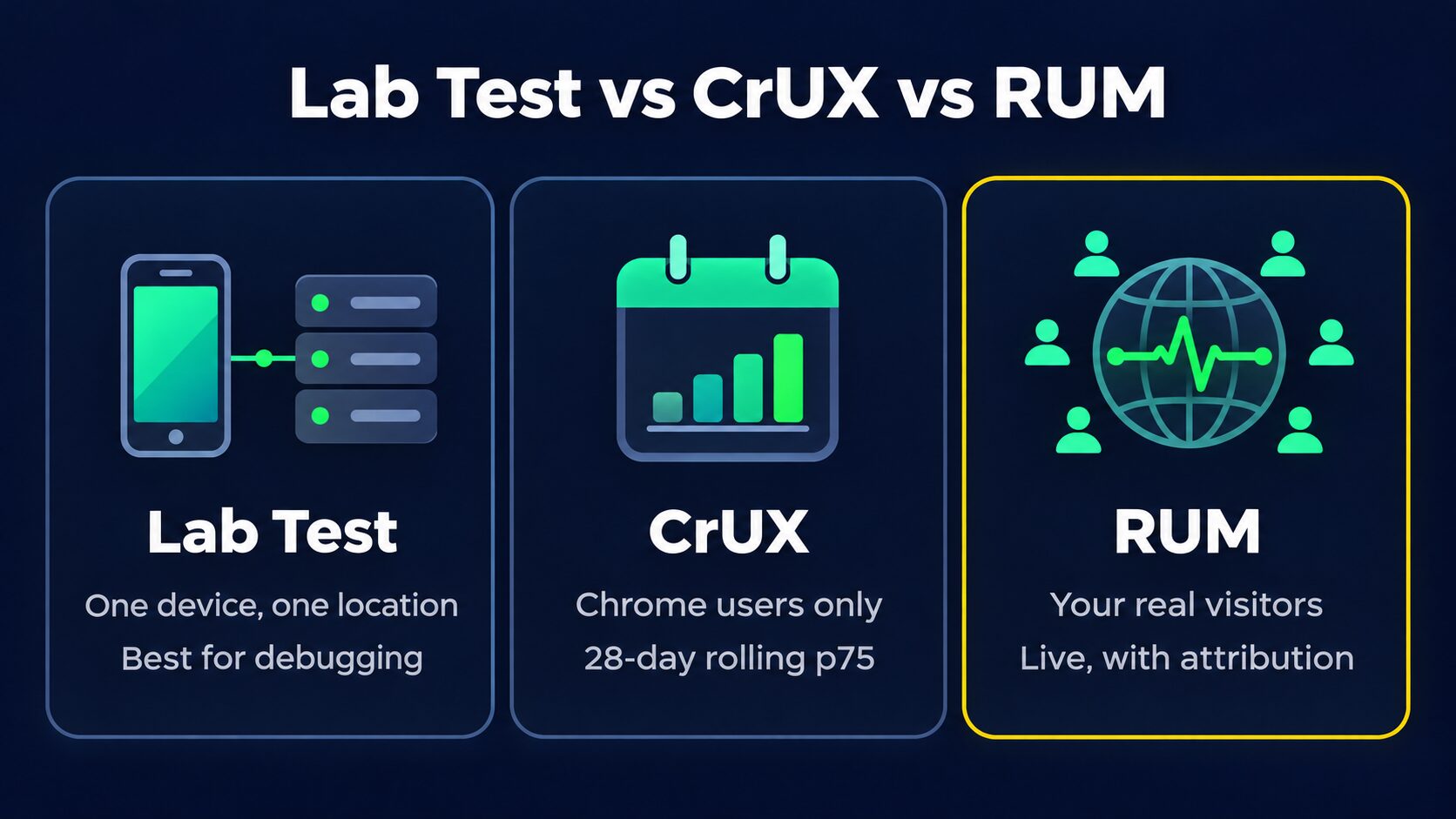
You can repeat and debug a lab test, but only RUM tells you whether real visitors got a fast page.
The two can disagree badly. One site owner on Reddit described their site often taking 5 to 10+ seconds to load when opened from Google search results, even though it scored excellently in both PageSpeed Insights and GTmetrix. A lab score measures one simulated visit from one data center, so it says nothing about your visitors' devices, networks, or cache state. If your scores look great but users complain, RUM is the first thing I'd add.
Before picking any alternative, I'd check these five things:
- RUM with attribution: element-level LCP and INP data, plus script attribution through Long Animation Frames. Without it, you only learn that a metric is poor and have to guess the cause.
- Lab tests from several locations and devices: so you can reproduce a problem near your users and verify the fix.
- CrUX data: it's what PageSpeed Insights and Search Console show, so you want it next to your own numbers.
- Monitoring and alerts: scheduled tests catch a regression right after a deploy, long before it shows up in CrUX's 28-day data.
- Price per RUM page view: RUM is billed by page views or sessions, so work out what your monthly traffic costs on each plan before comparing entry prices.
For this list, I compared each tool's current pricing and feature pages on these five points. Our team has used SpeedVitals, DebugBear, WebPageTest, GTmetrix, and PageSpeed Insights extensively over the years. For SpeedCurve, Calibre, and RUMvision, this is an assessment based on their public documentation, and we didn't run a controlled benchmark of the tools for this article.
SpeedVitals
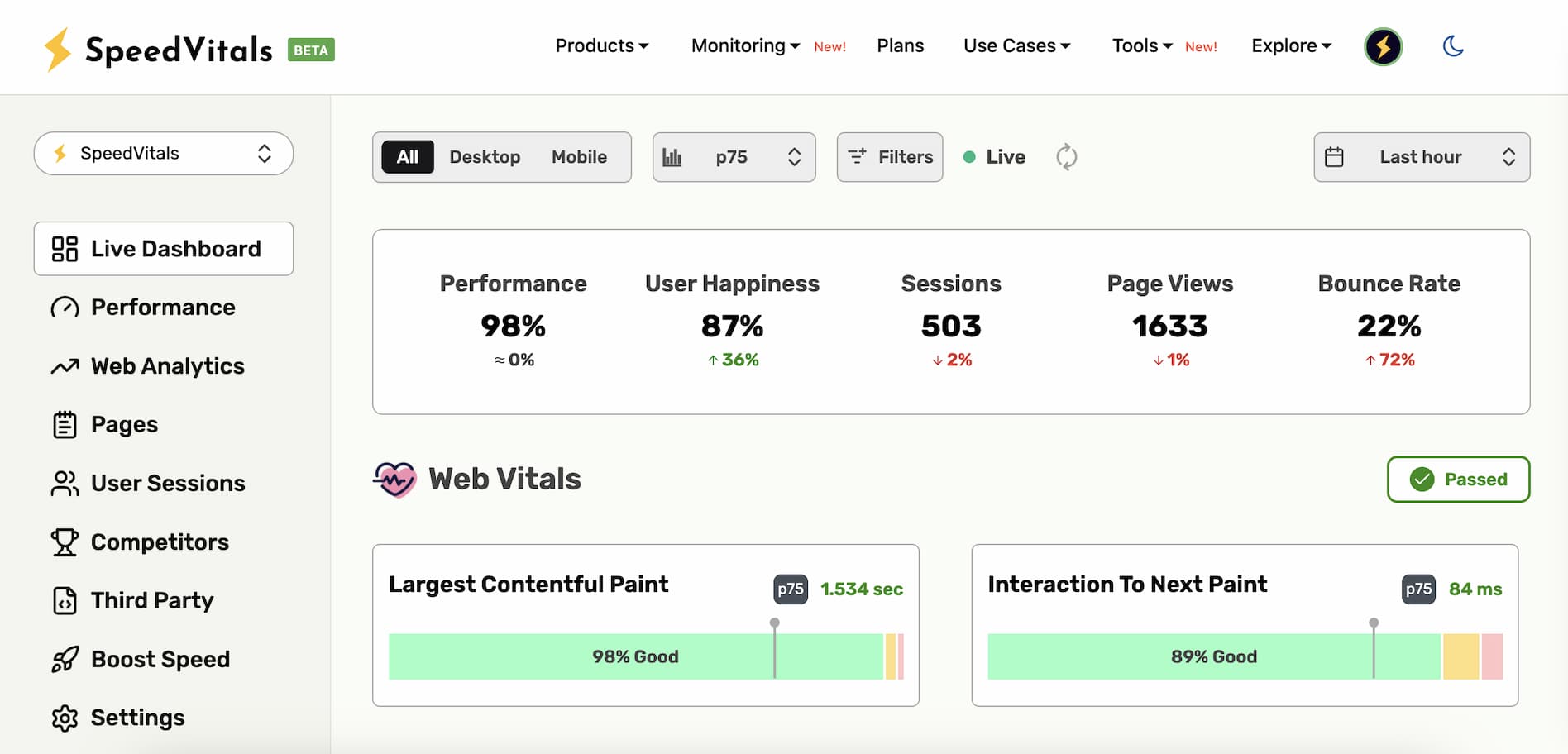
SpeedVitals covers both halves of what DebugBear does: lab testing with scheduled monitoring, and real-user monitoring of LCP, INP, and CLS. The biggest difference is that RUM comes with every plan, including the Free plan (5,000 page views a month on one website).
The RUM side includes:
- Live dashboard: p75 Core Web Vitals for your visitors, without the 28-day wait of CrUX.
- LCP and INP breakdowns: LCP timings, INP split into input delay, processing duration, and presentation delay, and the elements causing high LCP, INP, and CLS.
- Long Animation Frames by domain: shows which scripts, your own or third-party, keep the main thread busy.
- Request waterfall for real page views: the same waterfall as our speed test, but for actual visits.
- Third-party section: lists slow third-party scripts and suggests faster alternatives.
- Competitors: finds your SEO competitors automatically and compares your RUM data with their CrUX data.
- Web analytics built in: sessions, bounce rate, traffic sources, and country and city data, with no cookies.
- Easy setup: plugins for WordPress, Shopify, Joomla, and Drupal, plus SPA support for React, Vue, Svelte, and Angular apps.
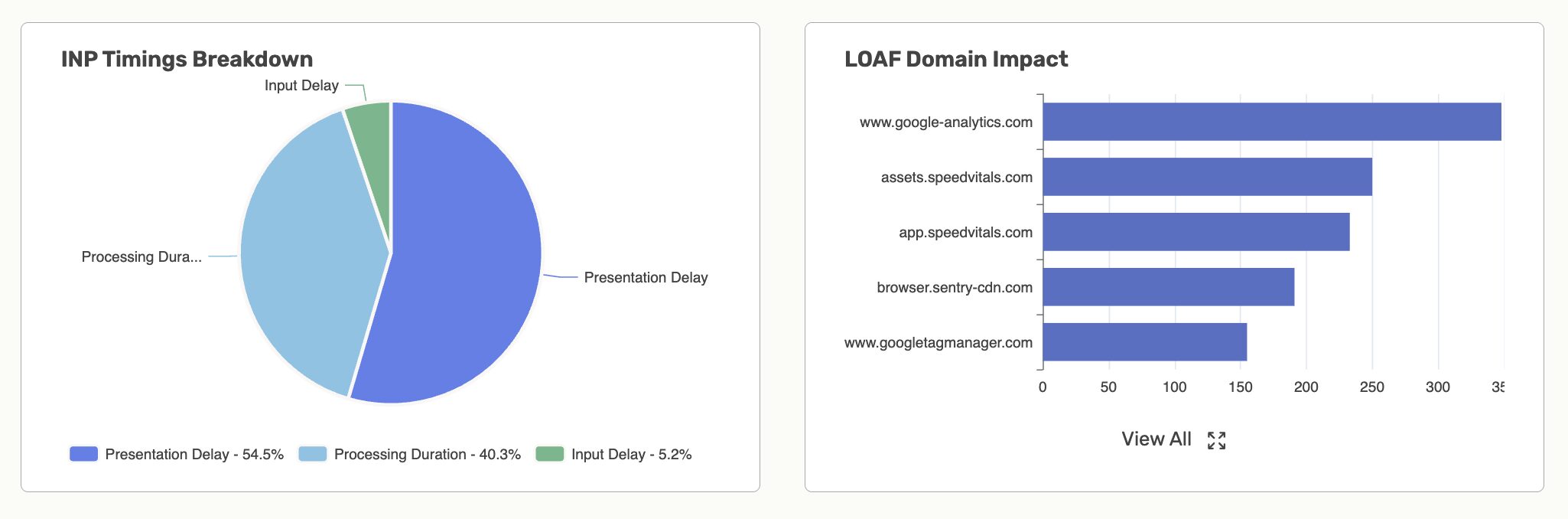
This screenshot is from our RUM beta in March 2025. Presentation delay (54.5%) and processing duration (40.3%) made up most of the INP, and the Long Animation Frames chart shows Google Analytics as the domain with the most long-frame time. A breakdown like this tells you where to start, and when a third-party script tops the list, the fix is often delaying low-priority JavaScript.
On the lab side, you get the website speed test with a waterfall, CLS visualizer, code coverage, and an auto-generated preload snippet for the LCP image. The TTFB test checks response times from 40+ locations with cache status and CDN detection, and the batch test runs one URL across many locations and devices at once. There are also no-code experiments, 12 months of historical CrUX data, and a free INP debugger that clicks through your page to find slow interactions.
These are the SpeedVitals plans:
| SpeedVitals Plan | Monthly Price | RUM Page Views per Month | RUM Websites | Speed Test Credits |
|---|---|---|---|---|
| Free | $0 | 5,000 | 1 | 15/week |
| Starter | $19 | 5,000 | 1 | 300/week |
| Growth | $49 | 20,000 | 3 | 750/week |
| Pro | $99 | 200,000 | 10 | 1,500/week |
| Ultimate | $399 | 1,000,000 | Unlimited | 3,500/week |
So $99/month on Pro gets you 200,000 RUM page views, while $125/month on DebugBear Startup gets you 100,000. At the higher end, Ultimate covers 1,000,000 page views for $399/month against 500,000 on DebugBear's $325/month Team plan. Yearly billing on SpeedVitals gives you two months free, and Pro and Ultimate can buy extra page views as an add-on.
Lab test locations go from 10 on Free and Starter to 35 on Growth and above, compared with the 30 locations DebugBear lists. Monitoring runs every 24 hours on the lower plans and every 3 hours on Ultimate, with email alerts from Starter, Slack from Growth, and webhooks from Pro.
Now the cons. SpeedVitals has no white-label reports, and RUM alerts and the RUM weekly digest are still marked as coming soon (alerts for synthetic monitoring are live). API access starts on the Pro plan, and team members start on Growth.
| Pros | Cons |
|---|---|
| ✅ RUM on every plan, including Free | ❌ No white-label reports |
| ✅ LCP and INP attribution with Long Animation Frames | ❌ RUM alerts are still coming soon |
| ✅ Request waterfall for real page views | ❌ API access only on Pro and above |
| ✅ Built-in web analytics, no cookies | ❌ 10 test locations on Free and Starter |
| ✅ Competitor CrUX comparison | |
| ✅ 35 lab test locations (Growth and above) | |
| ✅ TTFB test from 40+ locations | |
| ✅ Batch testing | |
| ✅ No-code experiments | |
| ✅ Cache status and CDN detection | |
| ✅ 12 months of historical CrUX data | |
| ✅ Email and Slack alerts, weekly digest | |
| ✅ Plugins for WordPress, Shopify, Joomla, and Drupal |
If you're moving away from DebugBear because of the price, SpeedVitals is the alternative I'll highly recommend. You can start on the Free plan, install the RUM script, and compare your real p75 numbers with your lab results before paying anything.
SpeedCurve
SpeedCurve combines RUM with synthetic tests. It has performance budgets, CI/CD integration, an API, and competitor benchmarking with filmstrips and side-by-side videos, which makes it a good fit for larger teams.
Its RUM collects INP attribution and Long Animation Frames data, the same kind of data DebugBear uses to explain slow interactions. Every plan also includes unlimited users and teams, which helps large organizations.
Pricing is built from RUM page views and synthetic checks. Starter begins at $90/month, and Growth begins at $576/month, which adds 13-month data retention and priority support. On the pricing calculator, 2 million RUM page views come to $270/month before the 20% annual discount, which is far cheaper per page view than DebugBear or SpeedVitals at that volume. There's no free plan listed.
| Pros | Cons |
|---|---|
| ✅ RUM and synthetic in one tool | ❌ No free plan |
| ✅ INP attribution with Long Animation Frames | ❌ 13-month retention starts at $576/month |
| ✅ Unlimited users and teams | ❌ Pricing takes some calculator math |
| ✅ Performance budgets and alerts | |
| ✅ CI/CD integration and API | |
| ✅ Competitor filmstrips and videos |
SpeedCurve is the better choice if you're a large team with millions of page views and a performance budget process in place. If you're already on SpeedCurve and want to cut costs, our list of SpeedCurve alternatives compares the options.
Calibre
Calibre puts RUM sessions, CrUX data, and scheduled synthetic tests in one place, with unlimited sites and URLs on every plan. It also has an automation API and a command-line client, and RUM sampling is configurable.
The Starter plan costs $75/month and includes 5,000 RUM sessions, 5,000 synthetic tests, and 3 seats. Team costs $150/month for 10,000 RUM sessions, 15,000 tests, and 10 seats. The next step, Company, costs $1,500/month paid yearly. There's a 15-day free trial but no free plan.
Calibre counts sessions rather than page views, and 5,000 sessions a month only covers a small site in full. Most growing sites will need to sample their traffic or move up a plan.
| Pros | Cons |
|---|---|
| ✅ RUM, CrUX, and synthetic on every plan | ❌ No free plan |
| ✅ Unlimited sites and URLs | ❌ Only 5,000 RUM sessions on Starter |
| ✅ Automation API and CLI | ❌ Big jump from $150 to $1,500/month |
| ✅ Configurable RUM sampling |
Calibre is a good fit for a small team that monitors many low-traffic sites, since the session quota is shared but the number of sites isn't capped.
RUMvision
RUMvision does only one thing: real-user monitoring. It has no lab tests, so you'll need a separate tool to reproduce and debug what it finds.
The Growth plan costs €150/month and covers 1.5 million page views across 2 domains, with weekly Core Web Vitals reports, daily regression alerts, a CrUX comparison with up to 10 competitors, and a breakdown of which first-party and third-party scripts slow you down. Scale costs €700/month, and extra page views cost €75/month per million. Billing is in euros, and yearly billing saves 10%.
Another Redditor running a site with about 100K users a month said they open RUMvision's weekly history when they want finer detail, or when they don't want to wait for the next monthly CrUX update. That faster feedback is the main reason to pay for RUM, since a change shows up within days instead of weeks. Just keep in mind that you'd still need a lab tool to find the cause.
| Pros | Cons |
|---|---|
| ✅ 1.5 million page views on the entry plan | ❌ No lab or synthetic testing |
| ✅ Daily regression alerts | ❌ No free plan |
| ✅ Competitor CrUX comparison | ❌ €150/month is steep for small sites |
| ✅ First-party and third-party script breakdown | ❌ Billed in euros |
RUMvision makes sense for high-traffic stores that already have a lab testing tool and only need RUM. If you're already on RUMvision and want lab tests in the same tool, our list of RUMvision alternatives compares the options.
WebPageTest
WebPageTest is the most configurable lab testing tool on this list. It's now part of LogicMonitor through Catchpoint.
The free Starter plan includes 150 test runs a month, filmstrips and video, Lighthouse, and custom scripts of up to 3 steps. Pro starts at $18.75/month for 1,000 runs ($180 if billed yearly) and adds scheduled tests, alerts, an API, no-code experiments, and 13-month retention. RUM isn't part of WebPageTest itself; it's sold as an add-on to LogicMonitor's enterprise platform.
However, the biggest reason I don't recommend it to most people is the same as in 2024: the interface has a steep learning curve that can scare away anyone new to web performance.
| Pros | Cons |
|---|---|
| ✅ Deepest test configuration | ❌ No RUM outside enterprise plans |
| ✅ Free plan with 150 runs/month | ❌ Steep learning curve |
| ✅ Filmstrip and video capture | ❌ Small free run quota |
| ✅ No-code experiments on Pro |
GTmetrix
GTmetrix is still one of the simplest lab testing tools, and it shows CrUX field data with trends of up to 6 months. But it has no RUM script of its own, so you only get field data when your site has enough Chrome traffic to appear in CrUX.
Lite starts at $5.99/month ($4.99 billed yearly) with 50 tests a month and one monitored page. Advanced costs $29.99/month for unlimited tests (fair use), 10 monitored pages, up to 28 locations, and hourly monitoring. Team seats only come with the $59.99/month Expert plan, and white-label reports only with Enterprise.
| Pros | Cons |
|---|---|
| ✅ Easy to use | ❌ No RUM |
| ✅ Cheap entry plan | ❌ No free plan on the pricing page |
| ✅ Waterfall, filmstrip, and video | ❌ Team seats only on Expert |
| ✅ CrUX trends up to 6 months | ❌ White-label reports only on Enterprise |
PageSpeed Insights
PageSpeed Insights is free, and it shows both Lighthouse lab data and CrUX field data (the 75th percentile over the previous 28 days). For a quick one-off check, that's often all you need.
But you can't pick the test location, there's no waterfall chart, and there's no monitoring or alerting. It also has no RUM, so a page or a site without enough Chrome traffic gets no field data at all. Our list of PageSpeed Insights alternatives goes deeper into these gaps.
| Pros | Cons |
|---|---|
| ✅ Free | ❌ No test location choice |
| ✅ CrUX field data | ❌ No waterfall chart |
| ✅ Simple interface | ❌ No monitoring or alerts |
| ❌ No RUM |
Which DebugBear Alternative Should You Choose?
Summing up, here's your best choice:
- Want RUM and lab testing without a big bill? SpeedVitals. Start on the Free plan, and Pro covers 200,000 RUM page views for $99/month.
- A large team with performance budgets and CI checks? SpeedCurve.
- Lots of small sites with very little traffic? Calibre, since every plan allows unlimited sites.
- Only need RUM for millions of page views? RUMvision or SpeedCurve, paired with a lab tool.
- Need deep lab tests with scripting for free? WebPageTest.
- Just checking one page once? PageSpeed Insights.
For most sites moving away from DebugBear, SpeedVitals gives you the same two halves (RUM and lab testing). It's far cheaper at the low end, where DebugBear has no RUM below $125/month, and it includes more RUM page views per dollar from the Pro plan upward. The only case where I'd look elsewhere is a site with millions of monthly page views that needs nothing but RUM, where RUMvision and SpeedCurve cost less per page view.
Once RUM shows you which pages and metrics are slow, our guide on website performance optimization ranks the fixes by impact.